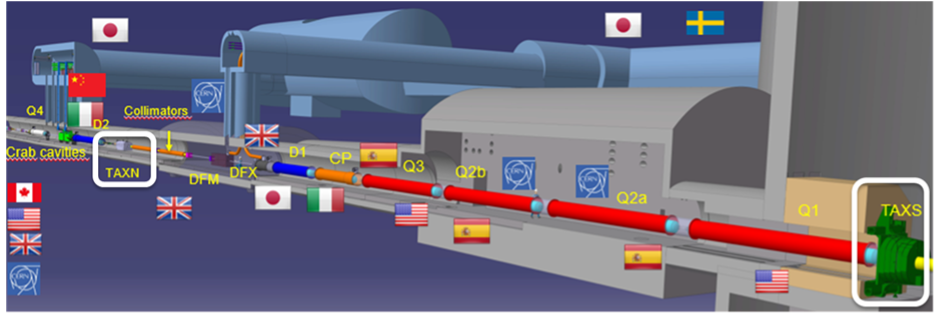
First two neutral beam absorbers, TAXN, arrive at CERN for HiLumi LHC
By Javier Fernandez Roncal and Florence Thompson (CERN)

The first two sets of copper clam shells for the neutral beam absorber (Target Absorber for Neutrals, TAXN) have been delivered to CERN, marking a key milestone in the procurement of the absorber cores for the High-Luminosity (HiLumi) LHC upgrade.
The TAXN is the new neutral beam absorber designed to replace the existing one, TAN, after Long Shutdown 3. Four of them will be installed, one each side of the ATLAS and CMS collision points. TAXN’s function is to intercept forward high-energy neutral particles produced in the collisions, thereby protecting the downstream dipoles (D2 and onwards), whilst providing sufficient aperture to meet the enhanced optics requirements of the HiLumi LHC.

With two sets of clam shells for the TAXN now received, two sets remain pending delivery and expected to arrive in the next couple of months. The absorbers will be assembled with Y_Chambers, cooling pipes, supports and other elements which will complete the assembly and be used to validate the cooling and bakeout cycle.