
About the High-Luminosity LHC
Read below to explore what the High-Luminosity LHC is, why it is important, and its technologies.
The High-Luminosity LHC in a nutshell
The High-Luminosity Large Hadron Collider (AKA HiLumi LHC or sometimes written as HL-LHC) is the major upgrade to the current Large Hadron Collider (LHC), CERN’s flagship accelerator. It aims to crank up the performance of the LHC in order to increase its potential for discoveries after 2030, by increasing the luminosity – corresponding to a higher number of particle collisions, to generate more data for delving deeper into unanswered questions of particle physics.
This extraordinary technical endeavour hinges on a number of innovative technologies, including cutting-edge superconducting magnets, crab cavities for beam rotation, and high-power superconducting links, as well as developments in collimation, powering, protection, cryogenics, vacuum, diagnostics, modelling and beam handling.
After five years of design studies and R&D ending in 2015, this challenging project is now nearing the end of ten years of development, prototyping, testing and series production. Installation and implementation of some technology and infrastructure is already well underway, and the major installation work in the LHC tunnel is due to take place during Long Shutdown 3, when the LHC will be switched off between July 2026 and mid-2030.
You can read the CERN information pages about HiLumi LHC here.
What is luminosity, and what are the luminosity goals of HiLumi?
Luminosity is an important indicator of the performance of an accelerator: it is proportional to the number of collisions that occur in a given amount of time. The higher the luminosity, the more data the experiments can gather to allow them to observe rare processes.
Instantaneous luminosity is the rate of potential collisions at a specific moment.
Integrated luminosity is the total collected data size over a period of time, measured in inverse femtobarns (fb-1). One inverse femtobarn of integrated luminosity equates to 100 million million collisions.
The objective of HiLumi LHC is to achieve instantaneous luminosities of a factor of 5 to 7.5 larger than the LHC nominal value, thereby increasing the integrated luminosity by a factor of 10 beyond the LHC’s design value. This should enable the experiments to enlarge their data sample by one order of magnitude during the 12 years of HiLumi LHC operation compared with the LHC baseline programme.
By the end of 2025, the LHC had produced 500 inverse femtobarns of data over its lifetime. The HiLumi LHC aims to produce more than 250 inverse femtobarns of data per year, capable of collecting up to 4000 inverse femtobarns during its operational period.
Why HiLumi LHC?
Witnessing rare phenomena not yet observable
The phenomena that physicists are looking for have a very low probability of occurring and this is why a very large amount of data is needed to detect them. Increasing luminosity produces more data, allowing physicists to study known mechanisms in greater detail and observe rare new phenomena which occur below the current LHC sensitivity level.
For example, the HiLumi LHC could produce about 380 million Higgs bosons over its lifetime, compared with the roughly 55 million Higgs bosons that the LHC has produced since it began operating.
Getting the most out of the accelerator
In the coming years, many critical components of the accelerator will reach the end of their lifetime due to radiation damage and will thus need to be replaced. The upgrade phase is therefore crucial not only for the full exploitation of the LHC physics potential, but also to enable operation of the collider beyond the end of the nominal LHC exploitation in 2026.
What are the technologies behind HiLumi LHC?
Technically how this upgrade can be achieved is at the heart of the HiLumi LHC as upgrading such a large-scale, complex piece of machinery is a challenging endeavour which naturally takes time, effort and innovation. Details about each activity can be found on our Activities & Technologies pages.
This extraordinary technical challenge hinges on a number of innovative technologies, including cutting-edge niobium-titanium (Nb-Ti) and niobium-tin (Nb3Sn) superconducting magnets, compact and ultra-precise superconducting radio-frequency crab cavities for beam rotation, and 100-metre-long, high-power magnesium-diboride (MgB2) superconducting links with zero energy dissipation. The higher luminosities will also impose unprecedented demands on vacuum, cryogenics and machine protection, and requires new concepts for collimation such as bent crystals, advanced modelling for the intense beams and novel schemes of beam crossing to maximise the physics output of the collisions.
There are major associated upgrades to the ATLAS and CMS experiments for the high-luminosity era.
A detailed technical description of the project and its technological and operational challenges is provided in the HL-LHC Technical Design Report and the HL-LHC book.
What is the schedule and status of the project?
This major upgrade is now in full swing of implementation together with its companion upgrade programmes: the LHC injectors upgrade (LIU) and detectors (ALICE, ATLAS, CMS, LHCb).
After five years of design studies and R&D ending in 2015, the HiLumi LHC Project is now nearing the end of ten years of development, prototyping, testing and series production. Installation and implementation of some technology and infrastructure is already well underway and teams are gearing up ahead of CERN’s next Long Shutdown, Long Shutdown 3 (LS3), when the machine will be switched off from July 2026 to mid-2030. HiLumi LHC is due to start up after this shutdown.
During LS3, deinstallation of many parts of the LHC will take place, followed by installation of new equipment for the HiLumi LHC accelerator, and the associated high-luminosity upgrades of the ATLAS and CMS experiments.
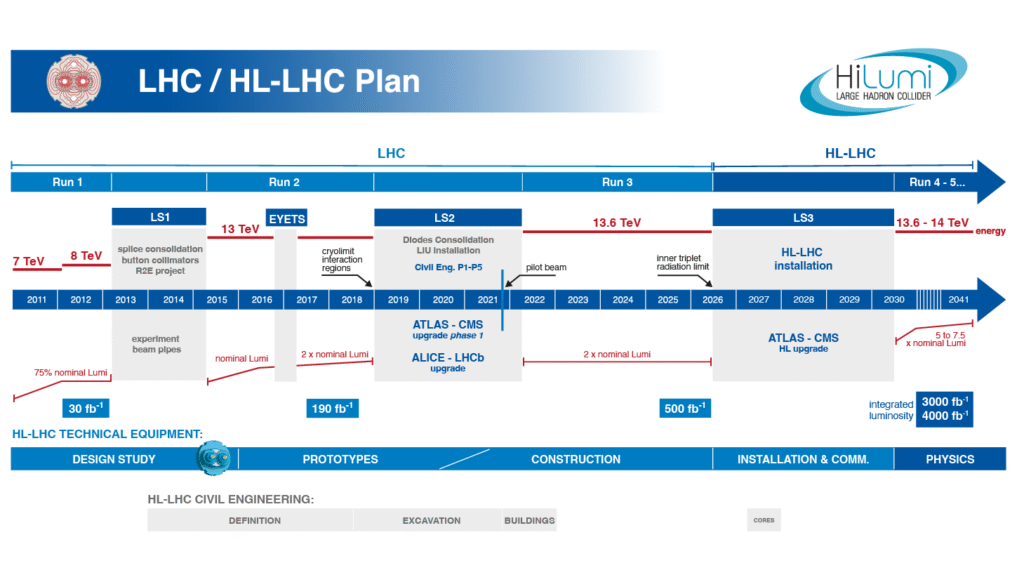
From the LHC to the HiLumi LHC
First beam in the LHC
LHC restarted
First physics in the LHC
HiLumi LHC Design Study begins
Discovery of the Higgs boson
LHC achieves 8 TeV collisions
LHC Run 1 ends, LS1 begins
HiLumi LHC as a priority project
HiLumi LHC Design Study concludes
Start of Run 2 & 13 TeV collisions
HiLumi LHC excavation works begin
LHC Run 2 ends, LS2 begins
HiLumi installations during LS2
HiLumi LHC galleries completed
Start of Run 3, record 13.6 TeV
End of Run 3
Start of LS3