
Knowing Hilumiers
Knowing HiLumiers is a project in which many members of the HiLumi LHC, past and present, were interviewed to gain an insight into the people of the project.
WP1 Project Management & Technical Coordination Bees
On the door of this cell hangs a sign with the words Project Management.
WP1 bees are there to offer support to the other cells. They work hand in hand with the various bee-offices.
Some of them are in charge of defining the project strategy, its scope and the technology needed. Others are responsible for ensuring the safety and the quality in each phase of the project.
There are also bees that follow the project’s budget very closely, and that coordinate the most technical aspects. Some are even in charge of disseminating the information: they are the speakers of the HL-LHC progresses.
Their main mission is to ensure that life in the Beehive runs smoothly.
Find out more about Project Management & Technical Coordination
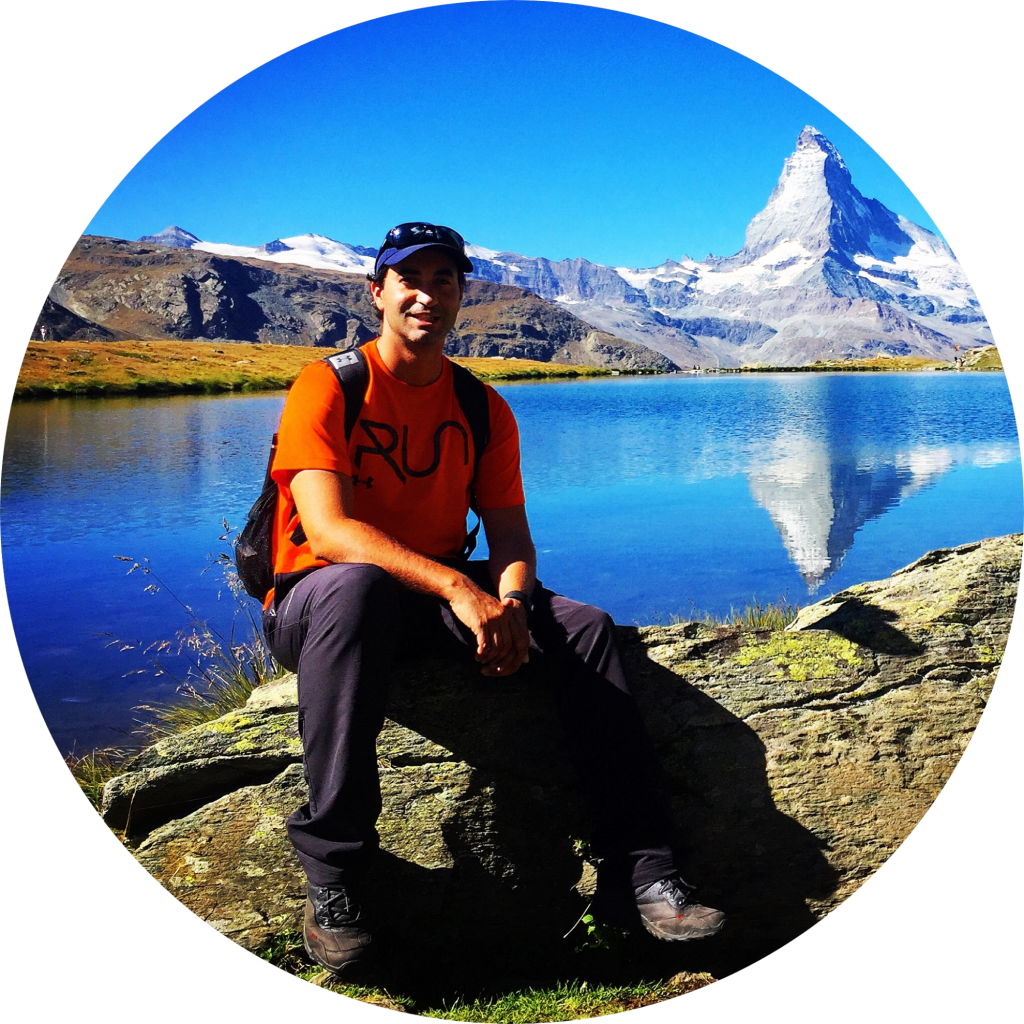
Héctor García Gavela
Read
Like Fito & Fitipaldis, Héctor grew up near the tracks. That is why he also knows “que la tristeza y la alegría viajan en un mismo tren”.
Fabero del Bierzo, a small mining town, which belongs to the Province of Leon, saw him grow, but Héctor’s sentimental passport has dual nationality. The Leonese one is accompanied by the Asturian. At the age of 18, he went to Gijón to study industrial engineering. Just after it, he began to work in the industry, involved in international projects that had him from one side of the map to the other. Until 2015, when CERN’s train passed in front of him. And he took it.
Five years later, he is still so happy with his decision and he is sure that if he had let it pass, he would have regretted it, a lot. In addition, Héctor had a special advantage in favour: his wife, Paula, from Asturias de sus amores, who was already at that time working at CERN. They have lived together in French territory since then. Prévessin-Moëns, a small village that, like many others in the area, has little bit more than a Mairie, a church and a library, gives them shelter. To them, and also to Casper, the puppy that for several months has given them lots of licks and endless walks.
The one in here and the one in Spain, are different lives. The alterne and the Asturian possibilities have nothing to do with the cramped French timetables. If it is 2 pm or 9 pm, it is not a good idea to start looking for a culín de sidra o for a cachopo. To “beber, salir, el rollo de siempre” is the same, but both zones play on equal terms in landscapes and in the green tones. However, Gijón is bathed by the Cantabrian Sea. 1-0 for Gijón. Perhaps, the draw is decided by the people, the friends from here with whom getaways, trekkings and barbecues are made. That second family that cushions and livens everything up.
About 40 kilometers from his childhood, in Villafranca del Bierzo, the poet Juan Carlos Mestre wrote this verse: Solo alguien hermoso puede hacer pan en un horno apagado. For Héctor, the impossible wear a costume of opportunity, of feasible. This attitude is also part of the CERN’s culture; it is something that is transferred between the people who collide there. When things seem unreachable to us, they are not the ones that are wrong.
Until September, CERN will have Héctor on its staff. Then? Todo se andará. If he is encouraged to dream, he prefers to do it without suitcases, passports or borders. He would desire to settle down to have more time, the time needed to clarify the future a little. In terms of work, it is enough to continue on the same railway line, like those wagons that used to leave loaded with coal from the Fabero’s mines. It is enough to sleep comfortably every night.
When September comes, another sweet introduction to chaos will start, but to Héctor, “que le quiten lo bailao”.
Irene García Obrero / CERN 2020
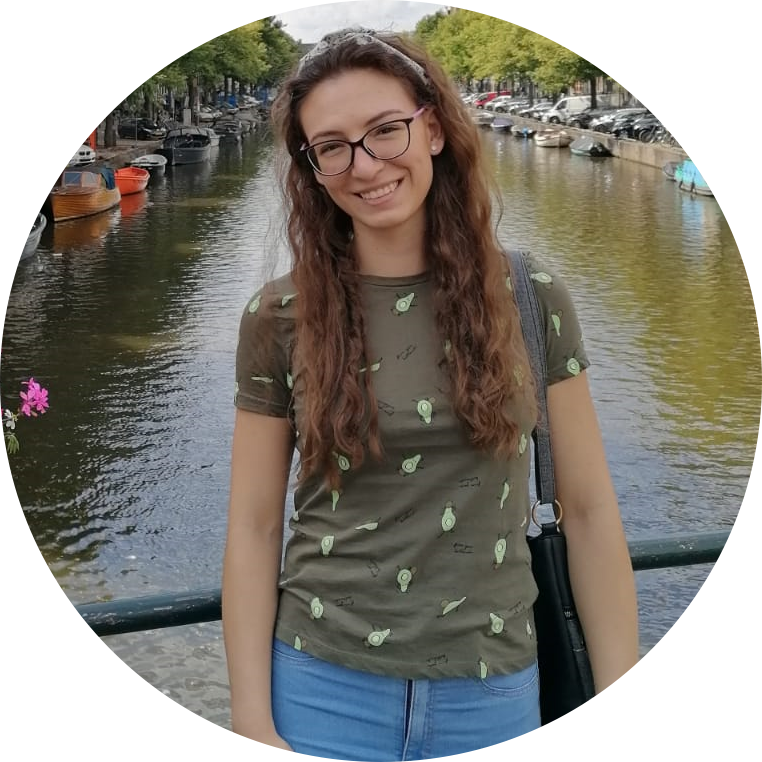
Sabrina Riebe
Read
Half German, half South African. Sabrina’s nationality belongs to the Germany of the philosophers, poets and musicians. Her birth, childhood and adolescence are based in Cape Town.
She remembers the mornings there. Waking up in her parents house, looking out of the windows and contemplating the beautiful views of Cape Town, bathed by the Atlantic Ocean. At night, as Kurt Darren would sing, “dis hemel op Tafelberg”, and Sabrina enjoyed looking at the stars, which were over the flat top of Table Mountain.
Her family still lives there and she misses them quite a lot. She also misses South African cuisine and the general lifestyle. Unlike Europe, in South Africa everything takes place outdoors. And she says it from the experience because, with her 23 years old, Sabrina has lived in a bunch of different countries.
After studying a Bachelor of Science in Information Technology in South Africa, she moved to Paris to study a Master of Science in Management of Technology – Information Systems. Frankfurt, Cologne, the small Saint-Genis-Pouilly… Sabrina lives now in Geneva and she works at CERN as a project control analyst on the HiLumi Project.
She started working at CERN not even a year ago, in September 2019. Being at CERN was a dream that she wanted to achieve since she was very very young. She loves the learning environment that CERN gives. To Sabrina, it is a place where new people with fresh ideas are constantly coming, people who are passionate about their achievements. Every day at CERN means a new adventure.
Sabrina is quite a dreamer. Lots of goals surround her. If she thinks about her future, she sees herself working kind of an interface between technical and business worlds. She very much enjoys the technical engineering side of things, but also business, and learning and understanding how and why everything fits together.
She could see herself mixing both one day with the aim of contributing to Humanity, because as the South African human rights and anti-racism activist, Nelson Mandela, said once: “What counts in life is not the mere fact that we have lived. It is what difference we have made to the lives of others that will determine the significance of the life we lead”. To Sabrina, it is also very important to make a positive contribution to other people’s lives.
She agrees with Nadine Gordimer, the South African writer and political activist who won the Nobel Prize in Literature in 1991. “A truly living human being cannot remain neutral”. She feels like, if you remain neutral, you are accepting all of the injustices in the world. It is when you have an opinion, and when you feel passionate about something, when you initiate a change towards a better future.
Sabrina feels like she is still growing and learning every single day. She likes to imagine herself opening a company for contributing to Humanity in some form. Mandela said that “everyone can rise above their circumstances and achieve success if they are dedicated to and passionate about what they do”.
And, for sure, Sabrina will do.
Irene García Obrero / CERN 2020

Miran Domajnko
Read
A party corridor is an elongated and special place where there is always a good mood. A place in which, from Monday to Friday, the coffee machine does not rest. It is also where Miran’s best memories at CERN are based.
Miran is currently living in Ljubljana (Slovenia), where Brane Mozetič, a poet and the director of the Slovenian Literature Centre of the city, was born in 1958. He wrote a poem entitled, there are things you can’t say, and that is what happens to Miran when it is time to talk about future dreams.
“An astronaut” is what a friend of his would say, but there is no answer for what he would like to be when he grows up. Not yet. As John Lennon used to sing, let it be. Miran prefers to stay down here. He is now working as a development engineer at RLS, a Slovenian company specializing in the design and manufacture of magnetic encoders.
Before this, he was a CERNie because in September 2019 he started an internship. He was part of the Configuration, Quality, Risk and Sourcing team of the HL-LHC Project, and he also belonged to the party corridor. He remembers fondly to walk down that corridor and to see the faces of the people thinking on the other side of the open doors.
He still remembers in detail a rainy day, one with the typical rain of the saddest scene of any drama film. Miran was walking down from building 112 to the main entrance, and a stranger’s car stopped next to him. “A long way to the main entrance, right?”, said the unknown CERNie. “Yes”, Miran replied. “Just jump in!”, the stranger offered him, and they drove together all the way down.
From those days as a CERNie, he also reminds how much he learnt at the professional level. In addition to his daily work tasks, he and his colleagues occasionally read and made presentations about books related to quality (in terms of engineering). It was an initiative of his supervisor to share fresh knowledge, and to keep it in constant motion.
Miran feels very lucky to have spent six months at CERN, where he was able to be very close to an impressive machinery that works thanks to the people. Those people who think and work hard in their offices, the CERNies that make incredible things happen, while having a good time in this international environment. It was six months full of great moments, nice conversations and good company.
So were the ski club and the violin encounters. Since Miran plays the violin in an Irish punk rock band, he decided to try an open jam session in Geneva. He only attended once and, now, he wishes that he went more times. But often we have to “be left to the wind”, as Mozetič wrote.
Miran had studied a bachelor’s degree in Materials Engineering at the University of Ljubljana, from 2014 to 2017, with two Erasmus experiences in between: the first one in Kraków (Poland), and the second one in Prague (Czech Republic). Then, he took a master’s degree in Mechatronics and Laser Technology at the University of Ljubljana.
Just as he enjoyed his internship at CERN, his two Erasmus, his time at university, his days in high school, and at primary school, Miran is enjoying his first days in what is now his new job. He just wishes to be happy.
As in the party corridor, all doors are open and life will take us anywhere. Even for the future dreams, “there will be an answer. Let it be”.
Irene García Obrero / CERN 2020
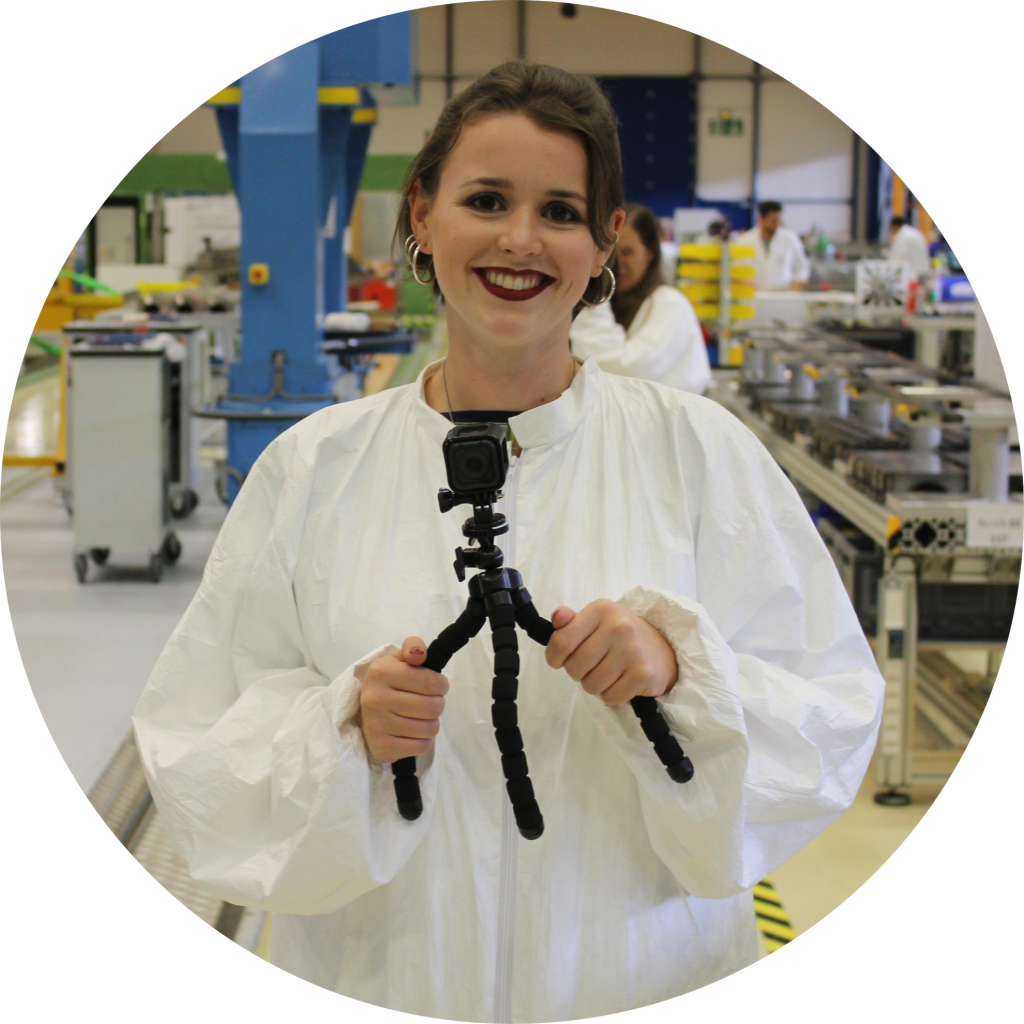
Beatriz Ferreira
Read
Among handcrafts, aircrafts and makeup, Beatriz combines the 25 pieces of her own puzzle. And, as Alamedadosoulna, a ska-reggae-soul group from Madrid, shouts in their concerts, she is so delighted to have met herself.
Beatriz is an aerospace engineer. She studied at the Instituto Superior Técnico (IST) in Lisbon, about three hours and a half from her home town: Braga. Beatriz lived there with her family and her dog, Sherlock, a 9-year-old beagle who was born without a paw. They used to play detectives together over the hills of Braga.
After finishing her degree, she specialized in mechanics with a master’s degree. Although it was also at the IST, Beatriz’s master took off with half-year of Erasmus experience in Pisa (Italy). Later on, she was working as a researcher in the Centre of Engineering and Product Development (CEiiA), in Matosinhos, and months later she flew to French lands.
Now, she is happy in the little Saint-Genis-Pouilly. She has been working at CERN for two and a half years, as a Quality & Production Engineer in HiLumi LHC. She feels that her dream is coming true every day because her dream could be empirical: to be where she already is.
Although she is no longer living, literally, on top of a hill, she has the Jura nearby, and she often goes all the way up to the top of it, where she sometimes runs into beauty. That beauty that Beatriz also finds on the inside of the warehouses where the machinery for the CERNies experiments is built, where she can see how the different pieces, like babies, grow and change shape. Because, for Beatriz, beauty has to do with elaboration: creating something beautiful, making something nice.
Beauty is an art, and art is subjective. Beatriz particularly enjoys one: the art of makeup, where the human face (sometimes, the whole body) becomes a blank canvas where imagination and madness are given full rein. That madness of which the Portuguese poet and doctor, Miguel Torga, spoke: the madness in which we recognize ourselves, the madness that makes us humans.
And the puzzles? Beatriz doubts because they reside on a peculiar border between art and science. The puzzles are not “absolute creation” because they come, somehow, prefabricated. They are not paintings, although they all have to do with pictorial art. The puzzles are not science either, but a methodology is needed to get a result. Like 2+2=4, the puzzles reach a unique solution, after which, there are those who decide to frame them and those who prefer to undo them.
To Beatriz, it is not necessary to be the best to achieve a goal. It is enough to have something unique, to be different. In essence: being ourselves. And, as Alamedadosoulna sings, wanting to be “como ese que sale en mi carné de identidad”.
Beatriz’s hands, which used to make crafts when they were little, could potentially design aircrafts and space rockets. Who knows. For now, she continues to live her dream. She is still delighted with her puzzle.
Irene García Obrero / CERN 2020

Jara Rodríguez Alonso
Read
“On my feet I wear two shoes for dancing, dancing to be free”. To the beat of Ska Jazz, Jara, a 24-year-old globetrotter, turns up the volume of Two Shoes, the song that she would recommend to anyone. Also on her feet, there is a pair of shoes that keep dancing.
Jara is the eldest of three siblings. She grew up in La Fresneda, a residential complex close to Oviedo, the capital city of one of the greenest regions in Spain: Asturias, patria querida.
Her interests range from nature to robotics, from climate change to new technologies. Jara studied a Bachelor of Science in Electronics and Automation Engineering. The two first years in Gijón (Asturias), the third one in Kraków (Poland) and the fourth one in Tampa (Florida). Now, she lives in Geneva, surrounded by friends employed by banks and international organization such as UN and CERN.
Since October 2018, she is working at CERN, specifically in HiLumi LHC and, more specifically in QUACO, a research project focused on the development of very peculiar magnets. Although in her team, everyone does a bit of everything, Jara is in charge of monitoring the production of those magnets, which two companies, one from France and the other from Spain, are building.
In the “pool of missing”, Jara would mark 1 to her father’s and her grandmother’s food, and also to the sea, that same sea that Rosalía de Castro asked to see from her bed shortly before she died. The Galician poet, a neighbor of Jara’s terriña, wrote: “it is fortunate the one who dies dreaming. Unfortunate the one who lives without dreaming”.
Jara’s curls dream short term. If she closes her autumn eyes, she imagines herself being part of a multicultural company, working together with people from various geographies with the aim of improving the lives of many others. Now, she is studying a master’s degree in Innovation and Digital Transformation, which focuses on the economic side, on business. Little by little, without stopping her shoes’ dance.
Jara may not be very good at painting, but she is not a disaster either. She is an optimistic woman who, even in dark and nebulous situations, she is able to see the good side, the one that only shines for a few. She bathes in stoic rivers while she remembers that “no hay mal que por bien no venga”.
Perhaps, she will become a successful business woman or she will toast with sidrina, somewhere in Europe, to celebrate great future advances in climate change. Perhaps, she will end up in a sports company, collaborating in improving the equipment and, therefore, the athletic performance. Perhaps not.
Jara hugs short-term dreams because she prefers not to make plans in that distant tomorrow and to continue here, dancing free with her same shoes.
Irene García Obrero / CERN 2020