Important quench protection systems delivered
With the delivery of the final units of the energy extraction system and quench heater power supplies in the last few months, an important part of quench protection for the High-Luminosity LHC has been produced and delivered, and focus is onwards to the remaining systems, tests and installations.
By Bozhidar Panev and David Carrillo, Edward Nowak, Daniel Calcoen, Daniel Wollmann (CERN)
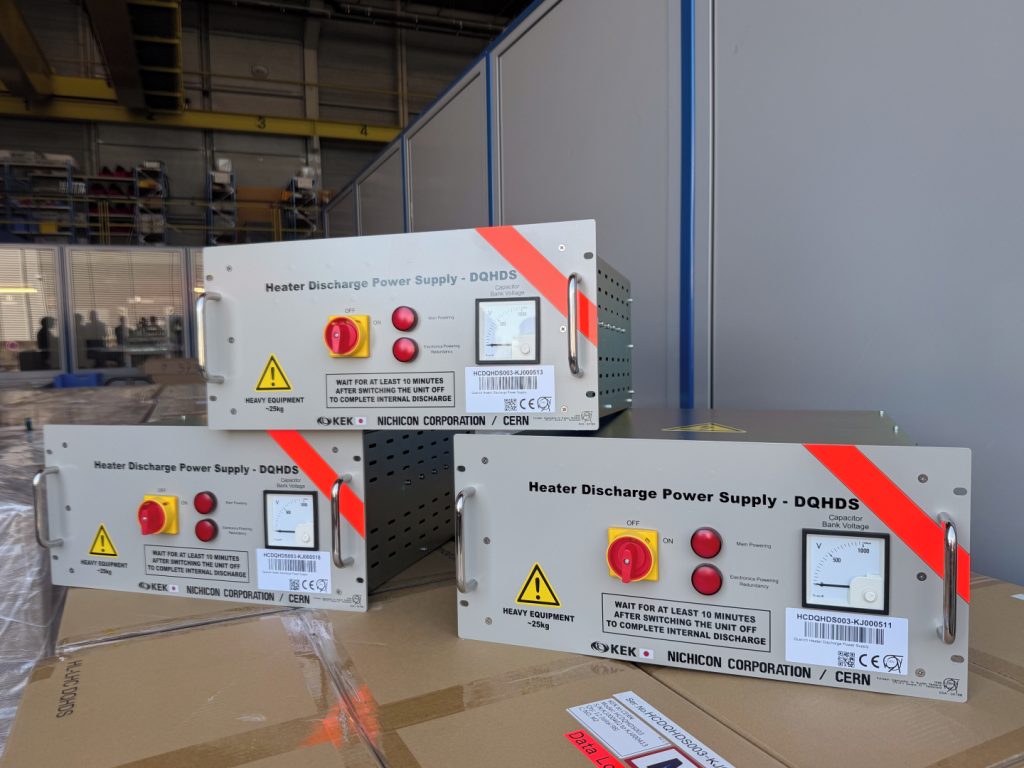
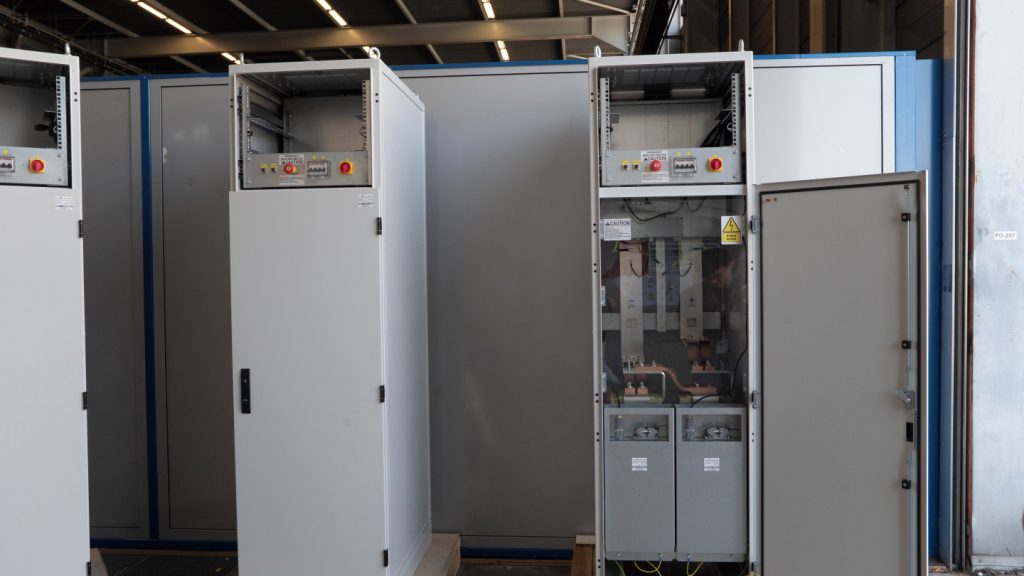
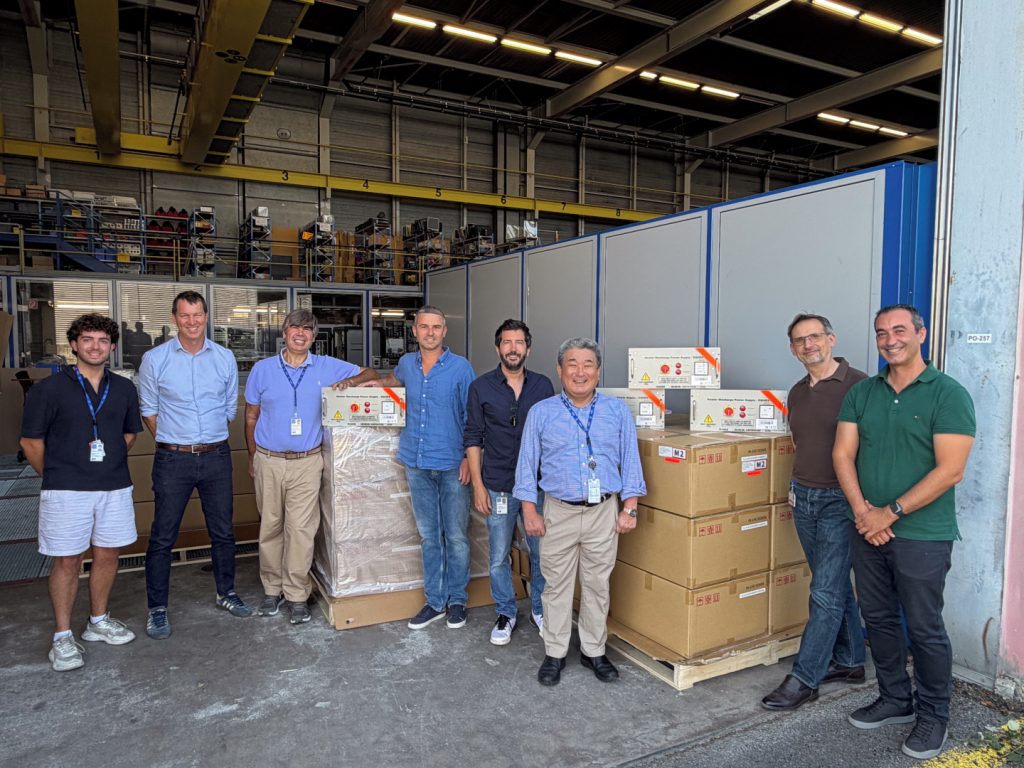
The final batch of 98 Quench Heater Discharge Power Supply (DQHDS) units arrived at CERN last month from KEK, Japan, completing the delivery of all 630 units foreseen for the High-Luminosity (HiLumi) LHC magnet protection systems. This comes following the delivery of the final 6 racks of the Energy Extraction Systems (EES) in July.
In the event of a quench, DQHDS units rapidly discharge high currents into the quench heater strips of superconducting magnets, spreading the transition to the normal-conducting state and distributing the stored energy over a large volume, thereby protecting the magnet coils from excessive local heating. Integrated with the CLIQ system, for which all units were already delivered to CERN last year, DQHDS forms a robust quench protection system for the Inner Triplet superconducting magnets of the HiLumi LHC.
This final delivery of DQHDS units from KEK is an important milestone in the long-standing collaboration between CERN and KEK, supported by Nichicon for the industrial production of the units. Provided as part of Japan’s in-kind contribution to the HiLumi LHC Project, KEK was responsible for the production, industrialisation, and follow-up of the Factory Acceptance Tests (FAT) of the DQHDS units, while their design, reception, and Site Acceptance Tests (SAT) were carried out by CERN. The SAT campaign of these final units was successfully completed by the end of September, marking the successful conclusion of the acceptance testing programme for all 630 DQHDS units supplied through the CERN-KEK collaboration, and all are ready for installation and commissioning.
After several years of design, qualification, industrialisation, production, and testing this moment reflects the hard work and commitment of everyone at KEK, Nichicon and CERN involved in design, reception, testing campaigns.
The Energy Extraction System plays a distinct, complementary, role to DQHDS/CLIQ by managing the electrical circuit as a whole (rather than individual magnets). In the event of a quench or another critical fault, these systems – which are based on fast vacuum switching technology – safely extract the magnetic energy stored in the superconducting circuits and dissipate it in dedicated energy absorbers, thereby protecting the magnets and associated equipment from thermal and electrical damage.
The delivery of these final 6 racks is a major milestone for the TE-MPE group at CERN, and marks the completion of the industrial production contract with the Polish company SESTO, representing the culmination of a long-standing partnership that started in 2017 with a joint research and development programme and progressed through the design, prototyping, qualification, and industrialisation of the new-generation EESs developed for the HiLumi LHC.
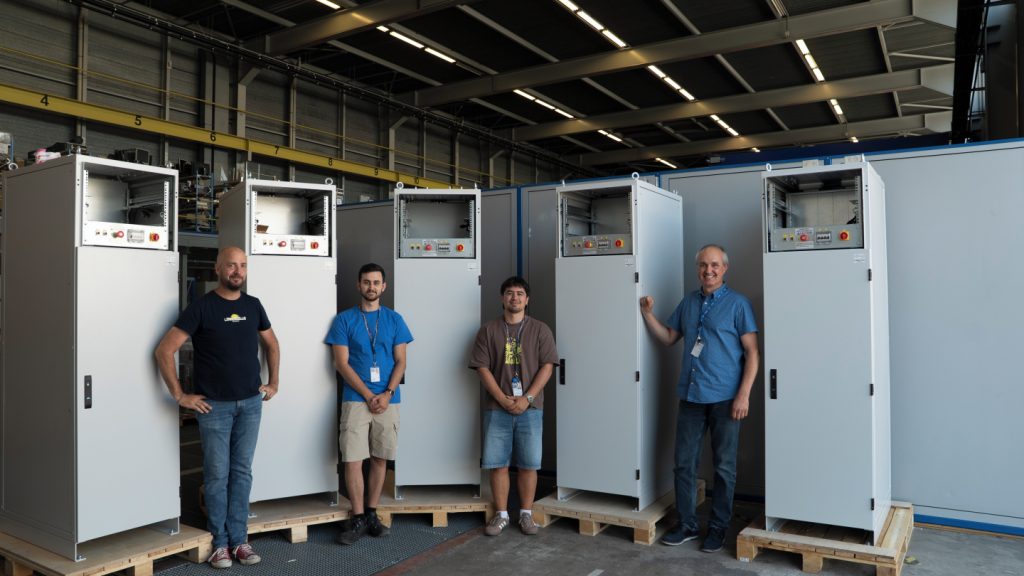
Now that the manufacturing phase of these key machine protection systems is completed, focus can shift towards the remaining systems, site acceptance tests, installation, and commissioning activities. The project has progressed according to the planned schedule, and these new systems will be installed in the newly constructed underground service galleries during Long Shutdown 3 (LS3).
View related photo collections here and here